

That is why SecurityTechLab exists.
SecurityTechLab was created to explain security technology in a practical, real-world way. Not as marketing hype. Not as generic product promotion. But as clear, field-oriented guidance for people who need to make better decisions about CCTV cameras, alarm systems, NVRs, smart security devices, access control, professional security systems, and security software.
Security technology should help people see, verify, respond, and prove what happened.
Security Started as Physical Protection
The first layer of security has always been physical.
Doors, locks, fences, gates, walls, lighting, guards, patrols, and controlled entry points are still the foundation of many security environments. Without physical protection, even the best electronic system can only record a failure after it happens.
- ✓Can someone enter the site easily?
- ✓Can a door be forced open?
- ✓Is the perimeter visible?
- ✓Are vulnerable areas protected?
- ✓Is there a human presence when needed?
This level still matters. A strong lock, good lighting, clear access routes, and visible deterrence can prevent many incidents before technology even becomes involved.
But physical security alone is no longer enough. Modern threats move faster. Properties are larger. Businesses operate longer hours. Remote access is common. Clients expect evidence. Managers need visibility. Insurance, audits, and investigations increasingly depend on documentation.
The Rise of Electronic Security
Electronic security added a new layer of visibility and reaction.
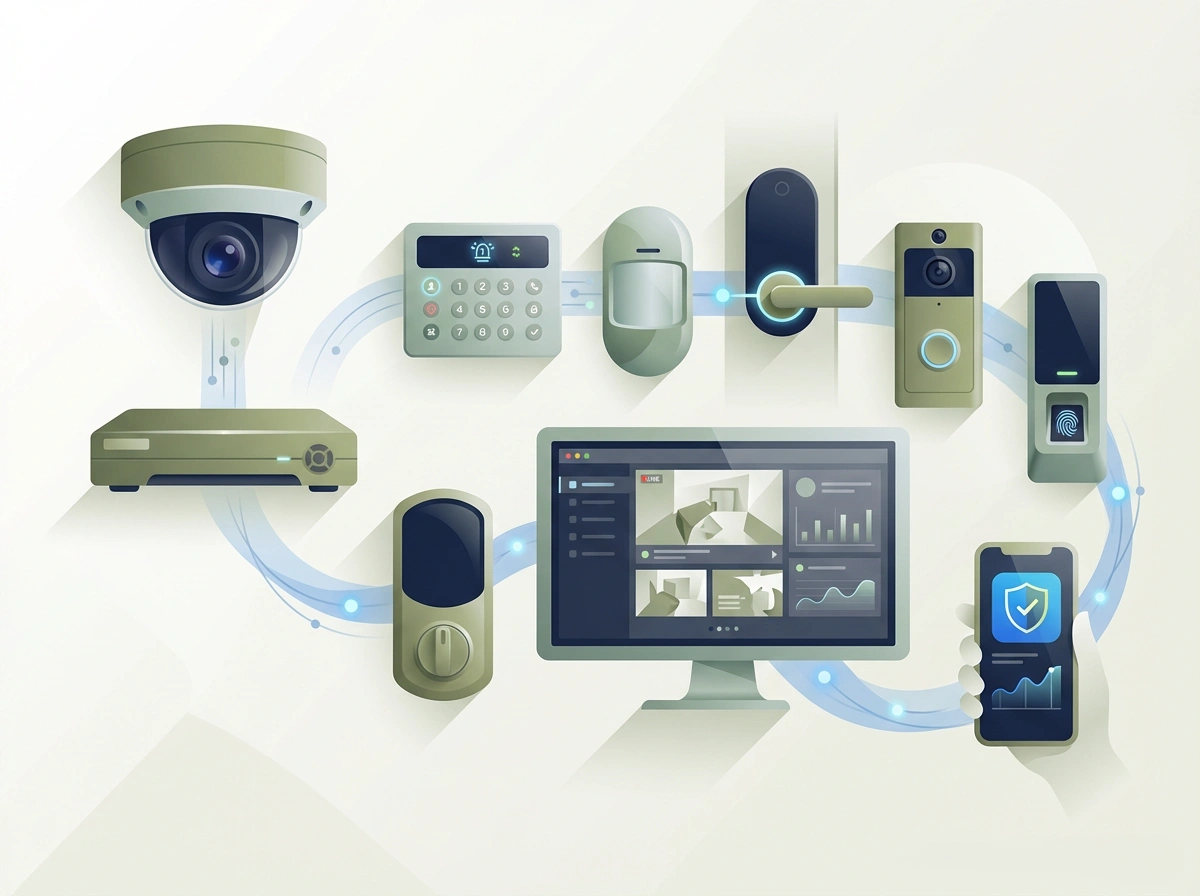
CCTV cameras made it possible to observe and record activity. Alarm systems created instant alerts when doors, windows, motion zones, or perimeter areas were triggered. Access control systems replaced simple keys with cards, codes, permissions, and event logs. NVRs and recording systems allowed video to be stored, searched, and reviewed.
This changed security from a purely physical function into an information system.
- 1A camera does not stop every incident. But it can show what happened.
- 2An alarm does not replace a door. But it can detect intrusion.
- 3An access control system does not guarantee trust. But it can show who entered and when.
- 4A recording system does not make decisions. But it gives evidence.
Security is no longer only about prevention. It is also about proof.
The Main Levels of Modern Security Technology
Modern security is usually built in layers. Each layer has a different role.
Physical Security
Locks, doors, gates, fences, lighting, barriers, safes, patrol routes, and physical property design. Physical security creates delay, deterrence, and controlled movement.
Electronic Security
CCTV cameras, alarms, motion detectors, door sensors, glass-break sensors, NVRs, intercoms, and access control devices. Electronic security detects, records, alerts, and supports response.
Smart Security
Smart locks, connected cameras, video doorbells, mobile alerts, app-based access, automation, and cloud-connected devices. Smart security adds convenience and remote control.
Professional Security Systems
Multi-camera surveillance, professional alarm installations, access control, guard tour systems, patrol verification, incident documentation, and operational reporting.
Security Software and Operational Proof
Dashboards, event history, patrol logs, incident reports, access logs, alerts, analytics, and audit-ready records. This layer turns activity into usable information.
A security system is only valuable if it helps people understand reality.
Why Security Technology Reviews Need Real-World Thinking
Many security products look good in advertisements. The problem is that real environments are more difficult than marketing photos.
- ✓A camera may look sharp during the day but perform poorly at night.
- ✓An NVR may offer large storage but fail under poor network conditions.
- ✓A smart lock may be convenient but unsuitable for a business entrance.
- ✓An alarm system may be technically advanced but generate too many false alarms.
- ✓A security software platform may look modern but fail to solve real operational problems.
This is why SecurityTechLab focuses on practical evaluation. The key question is not only: “What does this product claim?”
The better question is: “Will this actually work in a real security environment?”
The best security technology reduces uncertainty.
Security Technology Is Becoming More Integrated
The future of security technology is not about one device doing everything. It is about systems working together.
- ✓CCTV connects to recording.
- ✓Recording connects to remote access.
- ✓Alarms connect to notifications.
- ✓Access control connects to logs.
- ✓Patrol systems connect to proof.
- ✓Incident documentation connects to management decisions.
The more serious the environment, the more important integration becomes. For a homeowner, a simple camera or smart lock may be enough. For a small business, cameras, alarms, and access control may need to work together. For a professional security company, patrol verification, reporting, incident documentation, and client proof become essential.
Security technology should create clarity, not confusion.
The Mission of SecurityTechLab
SecurityTechLab exists to help readers understand security technology from a practical point of view.
- ✓CCTV cameras and surveillance systems
- ✓NVRs and video recording
- ✓Alarm systems and sensors
- ✓Smart security devices
- ✓Access control tools
- ✓Professional security systems
- ✓Guard tour systems and patrol verification
- ✓Security software and operational proof
The goal is not to recommend every new device. The goal is to explain what matters, what can fail, what buyers should check, and how security technology performs in real-world conditions.
Final Thought
Security technology is not just about buying equipment. It is about building layers of protection, visibility, response, and proof.
Physical security protects the space. Electronic security detects and records events. Smart security improves access and control. Professional systems connect people, devices, and decisions. Security software turns activity into usable information.
That is the direction of modern security.
And that is why SecurityTechLab exists: to provide practical, honest, field-tested guidance for people who want to understand security technology before they trust it.
Start with practical security technology guidance.
Explore SecurityTechLab articles on CCTV cameras, NVRs, alarm systems, smart security, professional systems, and the real-world decisions behind modern protection.
Read the SecurityTechLab Blog